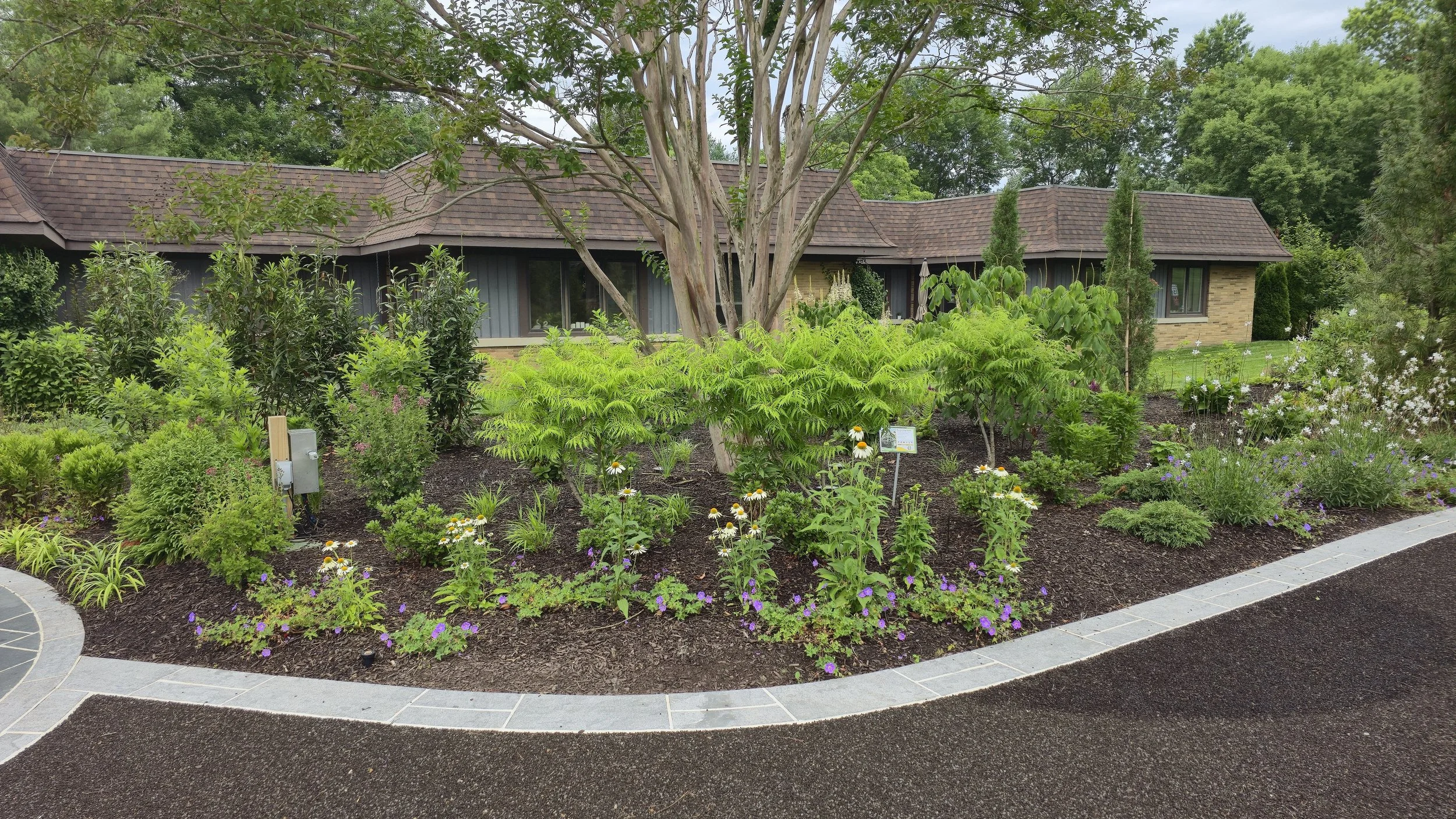
The part of a planting installation in Chadds Ford, PA that decides the result is finished before a single plant arrives on site. Soil structure, bed depth, drainage and the lines the beds are cut to are set first, and a planting put into unprepared ground will struggle regardless of how good the plant was when it left the nursery. Brandywine Valley clay makes this truer here than in many places.
At Brandywine, we approach horticulture with the same level of detail we bring to our hardscapes, with a crew that carries over 100 years of combined experience.
The two are the same discipline in our view, since a bed and a wall both fail for the same reason, which is what sits underneath them.
Related: Landscape Design Company in Chadds Ford, PA: How the Plan Comes Together Before Anyone Digs
What Does Proper Soil Preparation for a Planting Installation Involve?
Proper soil preparation means breaking the compacted layer, amending across the full bed instead of into individual holes, and getting the finished soil level right against adjacent surfaces. Everything starts below ground, with soil prep, bed lines and root zone care.
Heavy clay here benefits from organic matter worked through the profile, not laid on top, because a rich layer sitting over hard subsoil creates a bathtub that holds water around the roots.
The bed lines get cut at the same stage, so the edge a homeowner sees for years is set while the soil is open and easy to shape.
How Does Drainage Change What Can Be Planted?
Drainage narrows the plant list considerably. A bed that holds water through a wet February will take out broadleaf evergreens and most of the plants homeowners ask for by name.
Reading where water sits on the property comes before selection. In some positions the honest answer is to correct the grade or add a drain instead of continuing to replace plants that were given an impossible job, and that correction costs far less than a second round of planting.
Which Plants Suit This Part of the Brandywine Valley?
Plants that tolerate a cold, wet winter and a humid summer, and hold their structure through both, suit this part of the Brandywine Valley. Boxwood, hollies and well chosen evergreens carry the winter frame, while perennial borders give the seasonal rhythm.
Specimen trees are placed for canopy, privacy or as a statement instead of scattered evenly across the lot.
Deer pressure is a selection input here, not an afterthought, so deer resistance shapes the final plant list during design refinement before anything is ordered.
Related: Landscape Services in Chadds Ford, PA: The Order the Work Has to Happen In
What Happens to New Plantings in the First Two Growing Seasons?
New plantings spend their first two growing seasons establishing roots, which is mostly invisible. Watering is deep and infrequent to pull roots downward, instead of light and daily, which keeps them at the surface.
Mulch is held at depth without piling against stems, and pruning stays light while the plant settles.
The bed that looks a little open in its first August is usually the one that closes over properly in its second.
Why Place Plantings Against the Built Elements?
Plantings belong against the built elements because the two have to read as one piece. A seat wall with nothing softening its base looks unfinished, and a border with no structure behind it has nothing to hold it together through winter.
Setting bed lines against stonework, and choosing material for the mature size it will reach beside that stonework, is the part that makes a property look settled instead of recently assembled.
That’s why planting plans are drawn with the hardscape, not after it.
Plan Your Planting Installation With the Ground It Goes Into
Good plant material in prepared ground consistently outperforms better plant material in poor ground. That is why the preparation carries the weight, and why we spend the first day of a planting installation with a machine instead of with plants.
Brandywine Designs handles planting installation, horticulture and the design work around it for properties across Chadds Ford, Kennett Square, West Chester and Greenville.
Reach out and we will look at the ground before we talk about the plants. Schedule your planting consultation with Brandywine Designs.
In Summary
Which season suits planting installation in Chadds Ford?
Autumn is generally the strongest window here. Soil is still warm while air temperature has dropped, so roots extend without the plant carrying a full canopy, and winter rainfall does much of the watering. Spring plantings also establish well, provided somebody stays on the irrigation through the first summer.
How deep should a planting bed be prepared?
A planting bed should be prepared deep enough to reach past the compacted layer, which on a recently built property is often eight to twelve inches down. Brandywine Designs prepares the whole bed instead of individual planting holes, which stops roots circling inside a pocket of good soil surrounded by hard ground.
Why do new shrubs look sparse in the first season?
New shrubs look sparse in the first season because the plant is spending its energy below ground. Top growth stays modest while the root system extends into the surrounding soil, and visible filling in usually arrives in the second growing season rather than the first.
Related: Why Hiring the Right Drainage Contractor Matters More on Brandywine Valley Clay Soil